

ERP system examples usually get presented to you as a shopping list built for enterprise buyers, and that list is mostly wrong for a small e-commerce team. The systems are real and good at what they do. The problem is fit: a full ERP's inventory module was designed around internal warehouses and EDI suppliers, not the real-time marketplace APIs that decide whether your Shopify listing oversells at 11pm. This piece walks through seven real ERP system examples, what each one's inventory module actually covers, and the exact signals that tell you when a full ERP is overkill or underkill for a small DTC or marketplace operation.
What an ERP System Actually Is (And What the Inventory Module Does)
An ERP, or enterprise resource planning system, is one database that connects finance, HR, supply chain, and operations so those departments stop keeping their own separate spreadsheets. When a sale posts, the same event updates the ledger, the inventory count, and the fulfillment queue at once. That single source of truth is the whole point, and it's genuinely valuable once a business is large and complex enough to need it.
The part your team cares about is the inventory and supply-chain module inside that suite. It handles SKU records, purchase orders, reorder points, safety stock, warehouse locations, bill of materials, and demand planning. On paper that reads like a complete inventory system, and for a manufacturer with internal warehouses it usually is.
Here's the catch. ERP inventory modules were built around internal warehouses and EDI supplier connections, not around the storefront APIs of Shopify, Amazon, and Etsy. Channel-native sync to those marketplaces is deliberately outside the scope of most core ERP inventory modules. That single design decision drives every comparison in this article, so hold onto it.

Popular ERP Systems Overview: 7 Real Examples
Below are seven popular ERP systems that come up constantly, with who each is built for, the inventory capabilities it genuinely includes, and one honest limitation for a small e-commerce team. Treat this as a reference, not a ranking.
SAP S/4HANA
Built for large manufacturers and multi-entity enterprises. Its inventory module is deep: MRP-driven demand planning, multi-warehouse bin and zone management, multi-level bill of materials, and reorder logic that most other systems copy. If you run 10,000 SKUs across several plants, this is engineered for you. For a small DTC seller it's the definition of overkill, with no native Shopify, Amazon, or Etsy sync and an implementation that requires dedicated IT and consultants to stand up.
Oracle NetSuite
A cloud ERP commonly used by mid-market retailers graduating off spreadsheets. It includes demand planning, reorder-point automation, safety-stock settings, and multi-location inventory in one place, and it scales well as order volume climbs. The limitation for small teams is cost and configuration. Setting SKU-level reorder rules the way you actually want them usually means paying for implementation help, and channel connections to marketplaces are handled through add-ons rather than as a core, real-time feature.
Microsoft Dynamics 365 Business Central
An SMB-focused ERP that fits companies already living in the Microsoft ecosystem. Its strengths are clean purchase-order workflows, safety-stock and reorder-point settings, and item tracking that ties straight into finance. If your accounting and operations already run on Microsoft tools, the handoff is natural. The gap is the same as the others: no native, real-time marketplace sync, so a small store selling on three channels still needs a connector layer on top.
Sage Intacct
A finance-first ERP that's genuinely strong at accounting and multi-entity reporting. It carries basic inventory tracking, which is fine for service businesses or light-inventory operations. For a warehouse-heavy e-commerce team it's underkill on the inventory side. You'll feel the limits quickly if you need bin-level pick paths, deep demand forecasting, or tight channel sync.
Acumatica
A flexible cloud ERP that appeals to distributors and wholesalers. Its inventory strength shows up with the warehouse management add-on, which handles multiple bin locations, transfers, and pick and pack workflows well. It's a solid fit if you manage a real warehouse with lots of locations. The trade-off for a small e-commerce team is the setup effort and the fact that marketplace connectivity again sits outside the core, added through integrations.
Odoo
An open-source, modular ERP that lets you switch on only the pieces you want: inventory, purchase orders, bill of materials, manufacturing. It's attractive to technically comfortable teams willing to configure or self-host, and the pricing model is friendlier than the big suites. The honest limitation is that Odoo rewards configuration effort. Getting reliable, low-latency sync to Shopify, Amazon, and Etsy typically means third-party modules and maintenance work that a lean ops team may not have time for.
QuickBooks Enterprise
Accounting-first software with limited inventory tracking bolted on. It's a common starting point because so many small businesses already keep their books there, and its Advanced Inventory features cover basic bin tracking and reorder points. Most sellers outgrow its inventory side well before its accounting side. Once you're managing real channel complexity or bundles, QuickBooks becomes the tool you keep for finance while you move inventory somewhere purpose-built.

ERP Deployment Types: Cloud, On-Premise, and Hybrid
Before you weigh any of these ERP system examples, know how they get deployed, because that choice shapes cost, speed, and who has to maintain it.
Cloud (SaaS) ERP runs on the vendor's servers and you access it through a browser. NetSuite, Business Central, and Acumatica lead here. You pay a subscription, updates are automatic, and there's no hardware to own. For a small team without an IT department, this is almost always the practical path.
On-premise ERP installs on servers you own and maintain. Some large SAP deployments still run this way. You get maximum control and data residency, but you also absorb the servers, the upgrades, and the specialists to run them.
Hybrid ERP mixes the two, often keeping core financials on-premise while pushing newer modules to the cloud. It shows up in enterprises mid-migration off legacy systems.
For most DTC and marketplace sellers, cloud deployment is the only one that makes sense. Anything that hands you server maintenance is time you don't have.

What ERP Inventory Modules Do Well (and Where They Were Never Designed to Go)
This is a fit problem, not a quality problem. The vendors above are good at what they were built for. The trouble starts when a small e-commerce team asks an ERP inventory module to do things it was never designed to do.
The strengths are real
A full ERP gives you a unified ledger, multi-entity and multi-currency financials, deep manufacturing with multi-level BOM and work orders, and mature EDI connectivity to large trading partners. If those are your problems, an ERP solves them better than anything else. Nothing below argues otherwise.
The channel-sync gap
Here's the operational pain point most inventory modules pull channel data on a schedule, polling Shopify or Amazon every few minutes rather than reacting the instant a sale happens. A purpose-built inventory platform listens for a webhook push and updates counts in near real time. That difference is the oversell window. When the same last unit is in three carts across three channels, batch polling gives the race time to resolve against you. Real time is a latency threshold, not a slogan: a sync that updates in under a minute keeps that window small enough that the collision rarely costs you a sale.
The configuration cost
Setting reorder points and safety-stock levels at the SKU level inside a full ERP is genuinely hard to do alone. The logic exists, but exposing it, tuning it per SKU, and mapping your real lead times usually calls for a consultant and weeks of setup. For a five-person ops team, that's time and money spent before you've prevented a single stockout.
Make it concrete. Say a fast-moving SKU sells 40 units a week and your supplier averages a 21-day lead time. A sane reorder point sits near 120 units, with a safety-stock buffer of maybe 30 more to cover the weeks the shipment runs late. Now multiply that math across 800 SKUs with different velocities and lead times. In an ERP, encoding all of it by hand is the project that eats your quarter.
The demand-forecasting gap
ERP forecasting was built for stable, high-volume SKUs with steady sell-through. That's not the catalog most Organizely readers manage. Seasonal SKUs, handmade Etsy goods with irregular demand, and bundled products that share components confuse moving-average models that assume smooth history. The result is forecasts that look precise and read wrong for exactly the products where getting it right matters most.
Midmarket ERP Solutions for Growing Sellers
Between the enterprise giants and the accounting starter tools sits a midmarket tier built for companies that have outgrown spreadsheets but aren't running plants across continents. This is where most scaling e-commerce brands land.
NetSuite, Dynamics 365 Business Central, and Acumatica anchor this segment. They carry real multi-location inventory, reorder automation, and financial consolidation without demanding the multi-year rollout an SAP deployment often does. Odoo also competes here for teams comfortable with configuration.
The honest caveat: midmarket ERP still assumes you have someone to own the system, and it still treats marketplace sync as an add-on. A brand doing 500 to 2,000 orders a month across Shopify, Amazon, and Etsy often gets more mileage from a focused inventory platform than from a midmarket ERP it half-implements. The ERP earns its place when multi-entity accounting or manufacturing depth enters the picture, not just growing order volume.
ERP Readiness Assessment: Are You Actually There Yet?
Before you shortlist any of these ERP system examples, run a quick readiness check. Buying too early is how small teams end up paying for software nobody has time to configure.
You're likely ready if:
You run more than one legal entity or currency and reconciling them by hand has become a monthly fire.
You have (or can hire) a person who owns system administration.
Manufacturing, work orders, or EDI compliance are now part of daily operations.
Your finance, inventory, and fulfillment data live in disconnected tools that no longer reconcile cleanly.
You're probably not ready if the only pressure is a growing catalog or a second sales channel. Those are real problems, but they're inventory problems, not enterprise-accounting problems. Solve them with purpose-built inventory software and revisit the ERP when the readiness signals above actually appear.
ERP Selection Criteria That Matter for Small Teams
Skip the invented benchmarks. Answer these five questions honestly and the ERP vs inventory management software decision usually answers itself.
Criterion 1: SKU count and catalog complexity
Ask: are you managing enough distinct SKUs, variants, and bundles that a spreadsheet has clearly broken? Rising SKU count alone doesn't require an ERP. It requires real SKU-level control: per-SKU reorder points, safety stock, and locations. ERP inventory modules justify themselves when SKU complexity is tangled up with manufacturing depth and multi-entity accounting, not just a big catalog.
Criterion 2: Channel count and sync speed
Ask: are you selling on Shopify, Amazon, and Etsy at the same time? The moment you run more than one channel against shared stock, batch stock updates start creating oversells. This is where a purpose-built platform's real-time sync earns its keep and where a core ERP module, built for internal warehouses, leaves you patching a connector on top.
Criterion 3: Order volume and pick/pack throughput
Ask: is your team walking the warehouse inefficiently to find items? When order volume climbs and pickers can't reliably find stock, bin and zone locations and batch picking stop being nice-to-haves. You don't need enterprise warehouse management to fix this. You need simple, accurate bin-level pick paths, which even a lean operation benefits from at a few hundred to a couple thousand orders a month.
Criterion 4: Lead time variability and reorder automation
Ask: do your supplier lead times swing week to week? Classic ERP reorder logic assumes stable lead times and reorders when stock crosses a fixed point. If a supplier's lead time drifts from 14 days to 28, a fixed reorder point either orders too early and ties up cash or too late and stocks you out. AI demand forecasting that accounts for variance handles this better than a static reorder rule.
Criterion 5: Team size and IT resource
Ask: do you have dedicated admin or IT time to run an ERP? Full ERP implementation and upkeep assume someone owns the system. Most small ops teams don't have that person. If nobody on your team can spend weeks configuring and maintaining an enterprise suite, that's a strong signal to choose software that runs without one.

How Purpose-Built Inventory Software Covers the Gaps ERP Leaves
Here's what to look for in purpose-built inventory software, framed around the gaps above. Each capability maps to something an ERP inventory module either skips or makes expensive, and each is something a focused e-commerce inventory management platform like Organizely handles directly.
Real-time channel sync vs. batch ERP updates
The benefit is stockout prevention. When a unit sells on Shopify, every other channel needs to know before the next shopper adds it to a cart on Amazon. Push-based sync that reacts to the sale event, rather than polling on a timer, is what keeps counts from drifting across channels. Organizely syncs Shopify this way so the number on the listing matches the number on the shelf.
SKU-level reorder points and safety-stock rules without a consultant
The benefit is ordering before you run dry, without a services engagement. You should be able to set lead time, minimum stock, safety-stock buffer, and reorder quantity per SKU in minutes, not book a consultant for weeks. That configuration speed is the whole reason purpose-built tools exist for teams that outgrew spreadsheets but shouldn't be paying for an enterprise rollout.
AI demand forecasting for seasonal and long-tail SKUs
The benefit is forecasts that hold up for irregular catalogs. Moving-average models inside a traditional ERP assume steady history, which is why they stumble on seasonal spikes and long-tail Etsy items. Probabilistic forecasting reasons about the range of likely demand instead of a single smoothed line, which fits the seasonal and low-volume SKUs DTC sellers actually stock.
Bin and zone locations for small warehouses
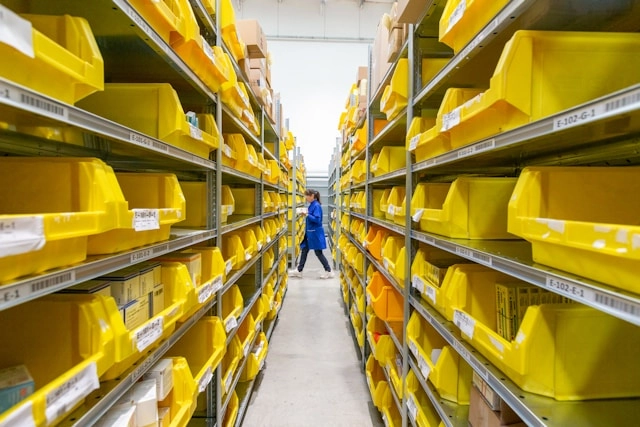
The benefit is faster, more accurate picking. Bin and zone locations aren't just an enterprise feature. Even at 500 to 2,000 orders per month, a picker who knows the exact bin walks a shorter path and pulls the right unit. Location is also part of knowing what's genuinely available to each channel, since committed stock in a bin isn't free to promise elsewhere.
Bill of materials for bundled and kitted products
The benefit is component-level accuracy without a manufacturing ERP. If you sell bundles or kits, one sold bundle should decrement each component. A bill of materials tracks that shared-component inventory so a single hero component selling out correctly marks every bundle that depends on it as unavailable, all without adopting full work-order manufacturing software.
ERP Trends and Innovations Worth Watching
The category isn't standing still, and a few shifts matter for small sellers weighing these systems.
AI-driven forecasting is the biggest one. Vendors are moving from static moving-average models toward machine learning that reads variance, seasonality, and promotions. The gap between an ERP's built-in forecasting and a dedicated AI demand forecasting tool is narrowing, but for irregular catalogs the purpose-built tools still lead.
Composable and API-first ERP is the second. Instead of one monolith, buyers increasingly stitch best-of-breed modules together over open APIs. That's good news for e-commerce, because it means the ERP can own accounting while a real-time inventory platform owns channel sync, without either fighting the other.
Embedded automation is the third: reorder suggestions, anomaly alerts on stock movements, and demand signals surfaced automatically rather than pulled from a report. The direction across the market is fewer manual reports and more decisions the system flags for you.
None of these change the core lesson. Even the most modern ERP still treats native marketplace sync as outside its lane, so the fit question survives every innovation cycle.
When You Should Actually Consider a Full ERP (Honest Guidance)
Sometimes the ERP is the right answer, and pretending otherwise would waste your time. If you run several legal entities or currencies and need consolidated, multi-entity accounting, a full ERP's unified ledger is built for exactly that and a lightweight inventory tool isn't.
If your operation involves deep manufacturing, multi-level BOM, work orders, routings, and shop-floor control, an ERP earns its complexity. That production depth is where systems like SAP S/4HANA and NetSuite genuinely pull ahead of any inventory-only platform.
And if large retail or wholesale partners impose EDI compliance requirements, mature ERP EDI connectivity is the practical path. When those three cases describe you, buy the ERP and pair it with the right implementation help.
Frequently Asked Questions About ERP System Examples
What are examples of ERP systems?
Common ERP system examples include SAP S/4HANA, Oracle NetSuite, Microsoft Dynamics 365 Business Central, Sage Intacct, Acumatica, Odoo, and QuickBooks Enterprise. Each connects finance and operations in one database, and each includes an inventory module of varying depth. For a small e-commerce team, the key question isn't which is best overall but which matches your SKU count, channel setup, and IT resources.
What are the top five ERP systems?
Five ERP systems that dominate most shortlists are SAP S/4HANA, Oracle NetSuite, Microsoft Dynamics 365 Business Central, Sage Intacct, and Acumatica. SAP and Oracle skew toward large enterprises and manufacturers, while Dynamics, Sage, and Acumatica reach into the mid-market and SMB space. None of them ship native, real-time Shopify, Amazon, and Etsy sync as a core feature, which is why marketplace sellers often pair or replace them with purpose-built inventory software.
What is ERP with an example?
ERP is software that unifies finance, HR, supply chain, and operations in a single database, and NetSuite is a clear example. In NetSuite, a sale updates the general ledger, decrements inventory, and triggers fulfillment from the same record, so departments work off one shared truth. That unification is powerful for complex businesses, though it's more than a small DTC store selling on a few channels usually needs.
What are ERP systems used for in e-commerce?
In e-commerce, ERP systems are used to tie orders, inventory, purchasing, and accounting together as a store scales into multiple locations, entities, or manufacturing. They excel at financial consolidation and supplier management. Their weak spot is real-time marketplace sync, so many small sellers run a dedicated inventory platform for Shopify, Amazon, and Etsy counts and reserve or delay the full ERP for when multi-entity or manufacturing needs make it worthwhile.